$0.74
For Australian early childhood education and care
Plan the week. Prove it’s safe.
Servery is an iPad app your cook uses to plan the weekly menu. It knows every child’s allergies, stops a dish reaching a child who can’t eat it, and produces the dated record an authorised officer asks for.
Every state and territory · $49 a month per centre · unlimited iPads · nothing leaves your device
Week 34 · 18–22 August
Draft · edited 9:12am
| Mon | Tue | Wed | Thu | Fri | |
|---|---|---|---|---|---|
| Morning | Fruit platter & yoghurt |
Wholemeal raisin toast $0.51 |
Corn & zucchini fritters $0.88 |
Banana bread $0.62 |
Pikelets & berries $0.66 |
| Lunch | Beef & vegetable pasta bake $1.94 |
Lentil & pumpkin dahl, rice $1.32 |
Satay chicken & noodles
peanut $2.10 |
Baked fish, potato, greens $2.28 |
Chicken & vegetable rice $1.88 |
| Afternoon | Cheese & cucumber crackers $0.58 |
Rice pudding, stewed apple $0.64 |
Hummus & veggie sticks $0.70 |
Fruit & yoghurt cups $0.72 |
Wholegrain toast fingers $0.49 |
Allergy rail · 7 of 41 children
TRTomas R. 2 · peanut, tree nut (anaphylaxis)
HDHana D. 3 · sesame (anaphylaxis)
AMAva M. 3 · egg
SKSam K. 3 · gluten — coeliac
BWBella W. 2 · dairy
Why services use it
Three things that keep directors awake.
If none of these sound familiar, you probably don’t need Servery. If two of them do, it will pay for itself the first time an authorised officer walks in.
The menu lives in one person’s head
It’s a Word document, or a laminated sheet, and the cook knows which child can’t have what. When they’re on leave, that knowledge goes with them.
“How do you know this menu is adequate?”
Quality Area 2 covers children’s health and safety, and food is part of it. Answering with a printed menu and good intentions is a hard place to be.
Nobody is watching plan expiry
An expired medical management plan on file is one of the most common findings in the sector, and nothing systematically flags it until somebody checks.
How it works
The laminated card above the bench, made live.
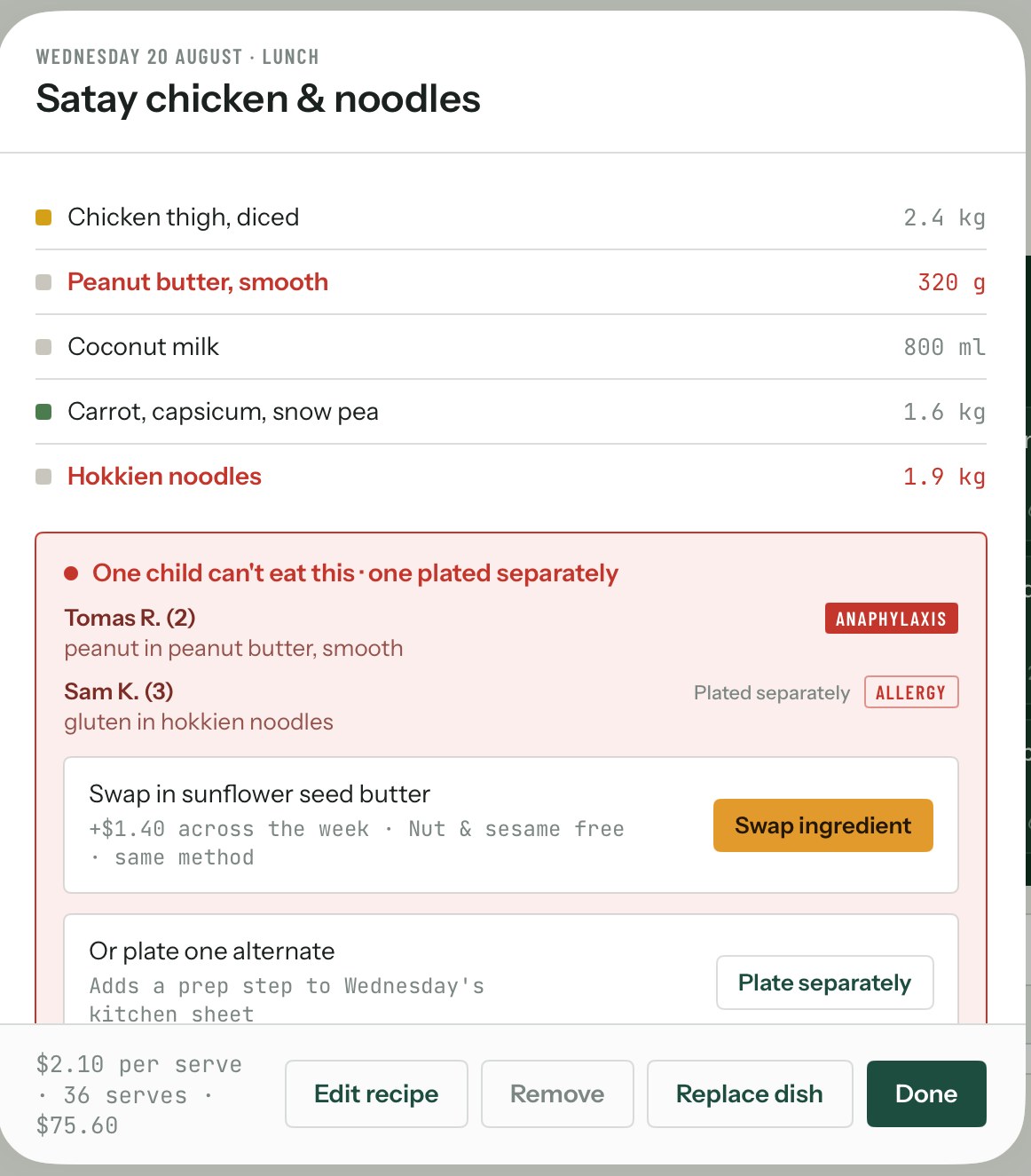
Every child with a dietary requirement sits in a strip under the menu. It stays quiet until you place something one of them can’t eat — then it flares, names the child, and offers the swap in the same breath.
1
Put your children in once
Add each child with a dietary requirement — name, age, what they react to, how serious it is, and when their management plan expires. Or import your roster as a spreadsheet and Servery shows you exactly what it read before saving anything.
2
Plan the week on the board
Copy last week and change what needs changing. Cost per child per day updates as you go, so you find out you’re over budget while there’s still time to do something about it.
3
Servery stops you before you publish
Put something on the menu a child can’t eat and that meal turns red immediately, names the child, and offers you two ways out: swap the ingredient, or record a separate plate. A week with an unresolved conflict cannot be published at all.
4
The kitchen gets one screen each morning
Kitchen Today shows just that day: prep times, how many serves, and who needs their own plate. Big type, no menus to navigate, readable at arm’s length with wet hands.
5
Export the record when you’re asked for it
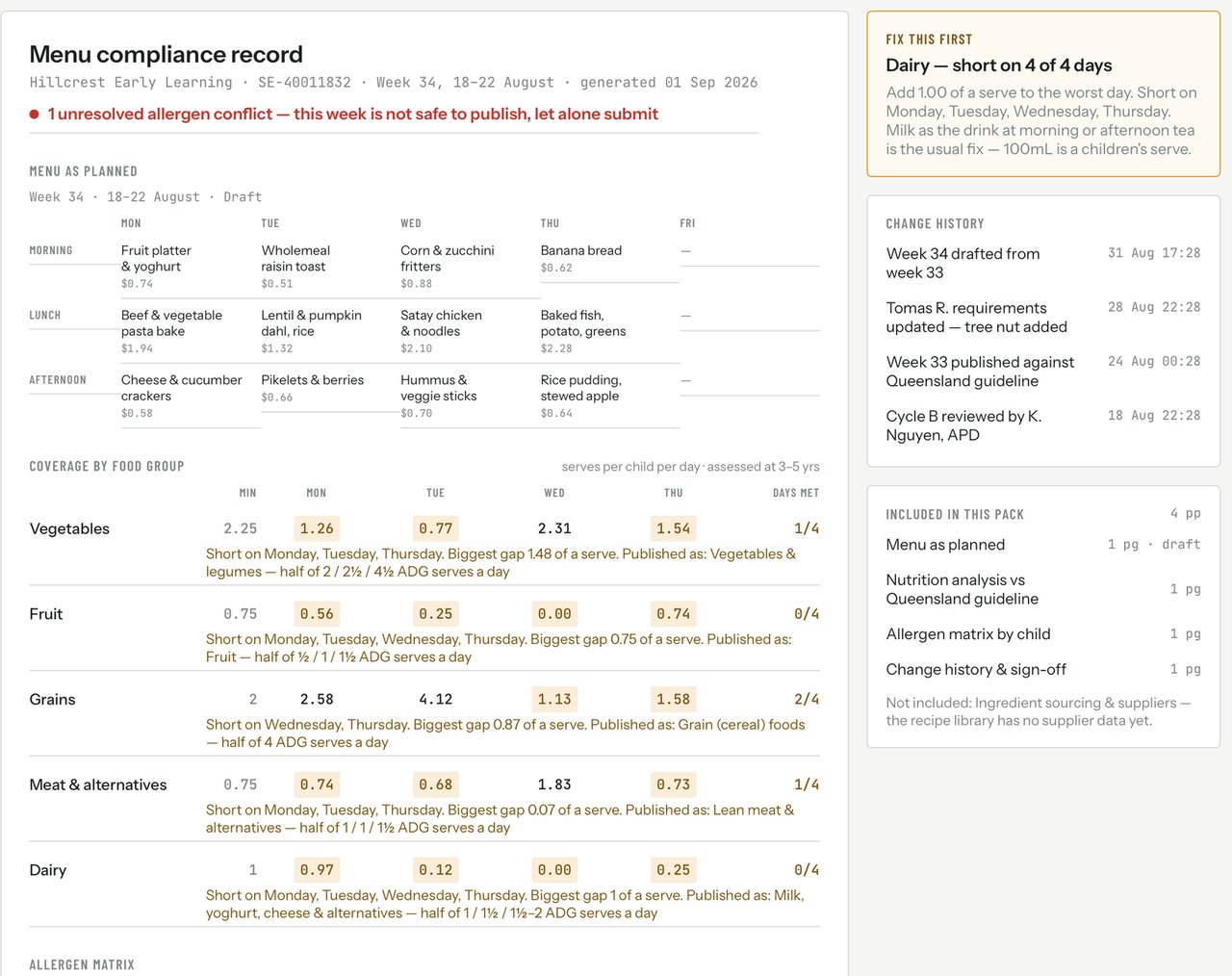
One tap produces a dated PDF: the menu as planned, every child against every day, nutrition coverage against your state’s guideline, and a timestamped history of every change.
Evidence Pack
The folder you hand an assessor, generated.
A dated PDF: the menu as planned, the allergen matrix of every child against every day of the week, and a timestamped record of every change and who made it. Included at every price level, because it’s the reason you’d subscribe.
What’s in it
Four pages, all dated
- The menu as planned, with cost per serve
- Coverage by food group, day by day, against your state’s minimums
- An allergen matrix: every child against every day of the week
- A timestamped history of every change and when it was made
Why it holds up
It doesn’t average the week
Plenty of tools would tell you a week averaged 90% of the vegetable target. Servery checks every day separately, because a day that fell short is a day a child was in care. It names the days, not a percentage.
Publishing locks the week. Edit it afterwards and it returns to draft until you republish, so the record can never quietly drift from what parents were given.
Where we’re up to
Nutrition coverage against your state’s guideline is in the app and works, for all eight states and territories, with every figure cited on the page. It is marked as provisional until an Accredited Practising Dietitian has signed off the recipe library it measures. We’d rather tell you that than have you find out in front of an assessor.
Every state and territory
Your state’s numbers, not somebody else’s.
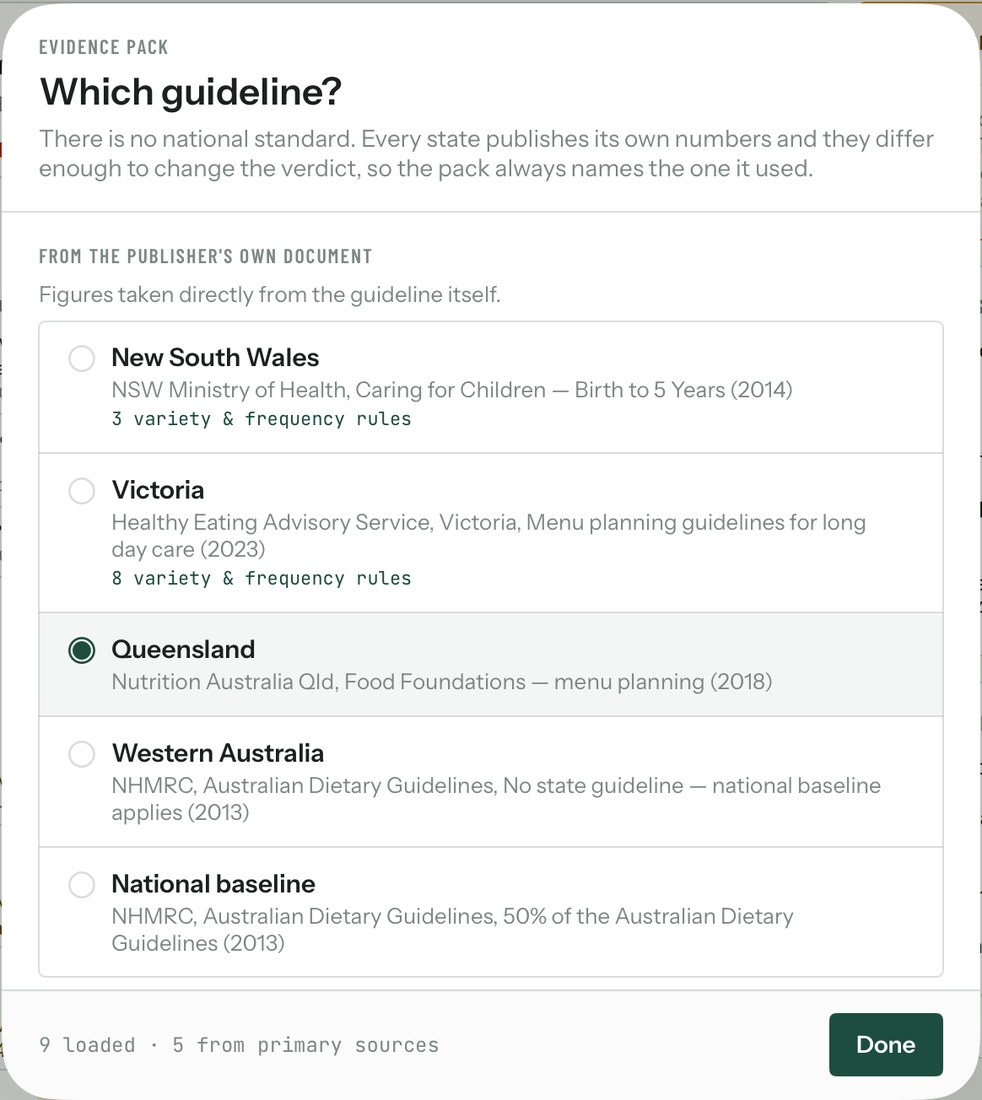
There is no national standard for what a service has to put on the menu. Each state publishes its own figures and they differ enough to change the verdict — the same week can pass in one state and fail in another. Servery carries all of them and prints which one it used.
From the publisher
NSW, Victoria, Queensland
Figures taken from the guideline documents themselves. New South Wales and Victoria also carry their variety and frequency rules — red meat, fish, wholegrain, vegetarian meals.
From a comparison
ACT, NT, SA, Tasmania
Those guidelines sit behind member access or are no longer government-endorsed, so their figures come from a peer-reviewed comparison — and the pack says so on its face, rather than in a footnote.
No state guideline
Western Australia
WA doesn’t publish one for early childhood. Servery assesses against half the Australian Dietary Guidelines and states plainly that’s what it has done.
Your data
It stays on your iPad. All of it.
Children’s allergies and medical management plans are health information. We’d rather not hold it, so we don’t.
What that means
- No account, no login, no server. Servery makes no network connections at all.
- We cannot see your children’s details, and could not retrieve them if asked.
- Records are encrypted while the iPad is locked — so put a passcode on it.
- Servery only stores a first name and last initial. There’s no field for a surname.
- Works with no internet. Plan, publish and export on a dropout.
Worth knowing
Your service holds it, not us
Because the records never leave your iPad, we aren’t a third party holding your children’s health information — your service holds it, exactly as it holds a paper enrolment file. Your existing privacy obligations to families cover it, and no new ones appear.
Full detail in the privacy policy.
Pricing
One price per centre. However many iPads.
One centre — one ACECQA service approval number — is one subscription, no matter how many children, staff or meals a day. Charging per device would price out the second iPad, and the second iPad is the point: the cook plans on one, the director exports the pack from the other.
$49
per centre, per month
or $490 a year
or $490 a year
- Every feature, including the Evidence Pack. No higher tier.
- Unlimited iPads, staff, children — and every meal you serve.
- Under a dollar per child per month at 60 places.
- Multi-site providers: $39 per centre per month from three centres.
- Cancel whenever. Everything already on your iPads stays readable.
Invoiced directly, not through the App Store. Download it and it opens on a sample centre you can plan a whole week against before you talk to us — it just won't take your own children or export a pack until your licence code goes in. One code covers every iPad in the centre, and it's checked on the device, so it works with the wifi off.
Questions we get asked
The things directors ask first.
Does it replace our menu, or our cook?
Neither. Your cook plans the same menu they always did — Servery checks it against your children as they go, and writes down what happened. You can start with a blank week and your own recipes.
Do we need an iPad each?
No. One subscription covers your whole service on as many iPads as you like. Most centres end up with two: one that lives in the kitchen, one the director uses.
Can it be wrong about an allergy?
It can only check what you’ve told it. If a child’s requirement isn’t entered, or a recipe has an ingredient nobody tagged, Servery won’t flag it — and the week will look fine. It also can’t read product labels, so supplier changes and “may contain” warnings are still yours to watch.
It is a second pair of eyes on your records. It is not a substitute for the person checking the plate.
Which state’s guideline does it use?
Yours — all eight states and territories are loaded, and you pick which one the pack is measured against. There is no national standard, and the states publish genuinely different numbers, so the pack always names the one it used and where that figure was published.
Is the nutrition analysis finished?
The guideline figures are, taken from each publisher’s own document. What isn’t yet reviewed is our estimate of how much each recipe contributes to each food group — that’s marked provisional in the app and on the exported pack until an Accredited Practising Dietitian has signed it off. Don’t present it as a nutritional assessment until we’ve told you that’s done.
What happens to our data if we stop paying?
It stays on your iPad and stays readable. Servery goes read-only — every week, child and history entry is still there, and the allergen checks still run, because an unpaid invoice is no reason to stop telling a cook about a peanut. It just won’t take new records or export a new pack, so export what you have to keep before your licence ends. Need one out afterwards? Email us and we’ll issue a code — we won’t hold your own compliance records back. There’s also an erase-everything option if you want it gone entirely.
How long to set up?
About an hour, most of it entering children. After that a week takes a few minutes, because you copy the last one.
Getting started
Open to services in every state and territory.
All eight jurisdictions are loaded and Servery prints which one it measured your week against, so it doesn’t matter where you are — a service in Hobart gets Tasmania’s numbers, not a national average nobody publishes. Download it, plan a week against the sample centre, and talk to us when you want your own children in it.
We’re a small team and we still want the cook’s opinion more than the director’s. Email us and you get us, not a support queue.
Servery is made in Queensland by Nexcentric Pty Ltd · ABN 84 682 372 952